

Australia’s electric vehicle (EV) market continues to grow rapidly, with predictions of 5x growth by 2027 to 1 million EVs on the road. As an engineer, project manager or electrician, how do you prepare carpark installations for the increasing demand for charging facilities? Whether a new carpark build or a retrofit in an apartment, paid parking facility, or commercial property, planning for the current and future demands of Electric Vehicle Supply Equipment (EVSE) requires the specification of a robust system that can handle the high-power demands of many chargers being used simultaneously.
From a planning perspective, there are two ways to plan an installation that will impact the short and long-term material and labour costs: centralised or decentralised. A centralised installation has been the default choice for many as it uses traditional materials and methods that are well understood by electricians. Each charger has its own electrical supply line running to the power source, and when future demands increase, a new installation has very similar material and labour costs to previous ones. In contrast, a decentralised installation requires a single supply line that is specifically designed for the high loads of EV chargers and other electrically demanding devices. Once it is installed, EV chargers can tap into this supply line at any time using a rapid connection module, meaning future additions or modifications require minimal labour and materials.
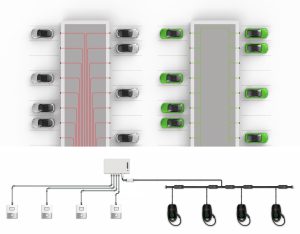
Figure 1. Comparison of a centralised EVSE installation (left) and a decentralised installation (right).
In Europe where EV adoption is advanced compared to Australia, decentralised installations have become the gold standard. This is supported by new flat cable systems such as podis® from German manufacturer Wieland, exclusively available in Australia through SEVR. The podis® cable is a power bus system featuring 5-cores, a rated voltage of 690V, and a rated current of 63A. It can support up to 20 chargers on a single length of cable (managed with Dynamic Load Balancing, DLB) – while 63A may not seem enough for this number of chargers, the limitation for most carparks and buildings is the available power for charging, not the cable or the capacity of the chargers. This is why DLB is so critical.
podis® is available with a range of accessories to streamline installation and upgrades such as connection modules (aka. tap-off modules), circuit breaker modules, cable end caps, mounting clips and more. In short, it is a complete EV infrastructure system.
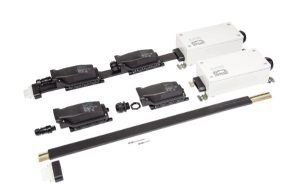
Figure 2. podis® flat cable alongside some of the accessories to support installation of EV chargers.
This system fast-tracks installation so that electricians can get in and get out quickly around other trades, and take on larger projects with smaller teams. For a new installation of EV chargers, it can be 65% faster to install a podis® system compared to typical centralised systems. When an additional charger needs to be added to the system, it is 88% faster to do this by adding a podis® connection module compared to the traditional requirement to run all new supply lines for each additional charger. This is because the connection module clips onto the podis® cable, and with 5 internal screws, safely pierces the cable sheath to form a connection. No cutting or stripping is required. Wires from the charger’s cable are inserted into corresponding plugs, and the cover of the connection module is closed to form an IP65 connection.
These time savings work out to be significant financial savings due to reduced labour costs. However, they also work out significantly cheaper due to the reduced materials required (e.g. cables, conduit, brackets, connectors) with every new charger. These combined savings can make you highly competitive when quoting for medium and large installations. You can use SEVR’s online calculator to work out just how much you can save based on the scale of a job, and work out the components that need to be ordered.
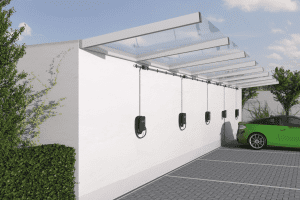
Additional benefits that your customers will enjoy include the minimal wall or ceiling space taken up by having a single flat cable instead of multiple conduits lined up, leaving more room for wall/ceiling-mounted storage. The podis® cable is also IK10 rated, and the connector is IK09, making them durable and long-lasting in parking environments. They are also UV resistant, and with their IP65 rating, are suitable for outdoor carparking installations, not just under cover.
 \
While Australia’s adoption of EVs may be slower than some other countries, our advantage is being able to adopt some of the most modern EV infrastructure that has been developed to deal with rapid growth. Explore more information about podis® on SEVR’s dedicated podis® website, utilise the online calculator, or contact the SEVR project team for a demo.